
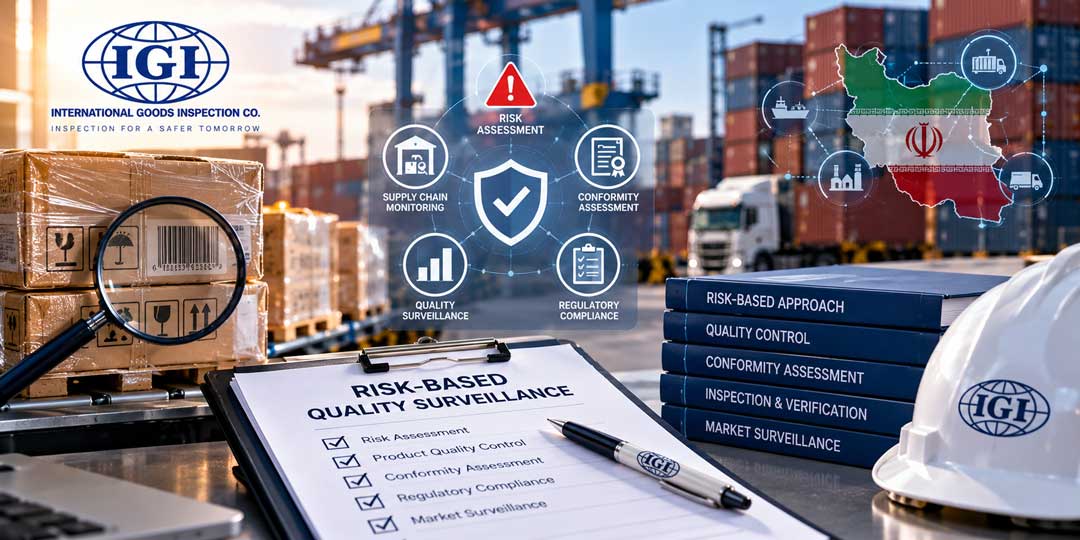
Risk-Based Quality Surveillance in Iran: The Role of Inspection in Conformity Assessment
Risk-Based Quality Surveillance and Conformity Assessment in Iran
Iran National Standards Organization has highlighted the use of a risk-based approach to surveillance and conformity assessment.
According to statements reported in September 2026, factors such as the likelihood of non-conformity and the severity of potential risks and consequences are considered when prioritizing surveillance activities.
This approach highlights the role of goods inspection, quality control, sampling and laboratory testing throughout production and trade supply chains.
What Is Conformity Assessment?
Conformity assessment consists of activities used to determine whether a product, process or service meets defined requirements.
These requirements may originate from standards, technical specifications, contracts, purchase orders or other applicable criteria.
Depending on the product and assessment objective, conformity assessment may involve goods inspection, sampling, laboratory testing, document review and evaluation of results.
Why Is a Risk-Based Approach Important?
Not all products have the same likelihood of non-conformity or the same potential consequences. Non-conformity in some products may have limited effects, while in other product categories it may create greater technical, commercial or safety risks.
A risk-based approach can help surveillance and quality-control resources focus on areas where closer monitoring may be required.
The Role of Goods Inspection
Goods inspection is an important tool for evaluating the quantity, quality and technical characteristics of products and consignments.
Depending on the inspection scope, activities may take place at manufacturing facilities, warehouses, ports, customs locations or other points in the supply chain.
Inspection may cover product specifications, quantity, weight, visual condition, packaging, marking, technical documentation and other defined requirements.
Pre-Shipment Inspection
Pre-Shipment Inspection or PSI is commonly used to evaluate goods before shipment from the country or location of origin.
Depending on the project, the inspection scope may include quantity, quality, product specifications, packaging, marking and other contractual requirements.
Pre-shipment inspection can provide buyers, sellers and other stakeholders with additional information about a consignment before shipment.
During Production Inspection
For some projects, quality control only at the end of production may not be sufficient. During Production Inspection allows selected manufacturing stages to be reviewed while production is underway.
This can help evaluate manufacturing progress and conformity with defined technical requirements before production is completed.
Quantity and Quality Inspection
Quantity inspection can include verification of quantity, count, weight and other measurable parameters.
Quality inspection focuses on defined product characteristics and specifications. The exact inspection scope depends on the product, contract and inspection objective.
Sampling and Laboratory Testing
Some product characteristics cannot be adequately evaluated through visual inspection or document review alone. In such cases, sampling and laboratory testing may be required.
Sampling should be performed so that the submitted sample represents the relevant product or consignment as appropriately as possible.
Laboratory methods can then be used to measure specified chemical, physical, microbiological or other parameters.
Inspection and Laboratory Testing
Inspection and laboratory testing are different but complementary activities.
Inspection can evaluate product condition, manufacturing processes, documentation, quantity, packaging and characteristics that can be assessed at the inspection location.
Laboratory testing is used when specific parameters require analytical methods and laboratory equipment.
Inspection of Imported and Exported Goods
Goods inspection can be used at different stages of international import and export transactions.
Verification of product specifications, documentation, quantity and quality can help identify potential discrepancies and provide technical information to the parties involved in a transaction.
Goods Inspection and Commercial Risk Management
Differences in quantity, quality, technical specifications or product condition can create disputes, delivery delays or additional costs.
Independent inspection can provide documented information about the condition of goods at the time of inspection and can form part of technical and commercial risk management.
Agricultural and Food Inspection
Inspection of agricultural and food products may involve consignment examination, sampling, assessment of selected quality characteristics and laboratory testing where required.
The exact inspection and testing scope depends on the product, contractual requirements and applicable standards.
Oil, Gas and Petrochemical Inspection
In the oil, gas and petrochemical industries, inspection services may be used for equipment, goods, materials and selected manufacturing or supply activities.
The inspection scope should be determined according to equipment specifications and project requirements.
Industrial and Consumer Goods Inspection
Industrial and consumer goods cover a wide range of products. Inspection requirements depend on product characteristics and defined specifications.
Quantity, quality, visual condition, packaging and other requirements may form part of the inspection scope.
Mining and Metals Inspection
Inspection in mining and metals may include verification of quantity, quality and technical characteristics and, where required, sampling and laboratory testing.
Marine Inspection
Marine inspection is another specialized inspection field and may include different control activities according to the operation, cargo and project requirements.
IGI Goods Inspection Services
International Commercial Goods Inspection Company (IGI) provides specialized goods inspection services across multiple industrial and commercial sectors.
IGI inspection services cover agricultural and food products, oil, gas and petrochemicals, consumer and industrial goods, pharmaceutical and chemical products, mining and metals, and marine inspection.
Learn more about IGI Goods Inspection Services.
Oil, Gas and Petrochemical Inspection Services
For specialized information about this sector, visit IGI Oil, Gas and Petrochemical Inspection Services.
Agricultural and Food Inspection Services
Information about agricultural and food inspection is available on the IGI Agricultural and Food Inspection Services page.
Laboratory Services Supporting Inspection
Where product assessment requires analytical testing, laboratory services can complement inspection activities.
IGI provides specialized laboratory services in chemistry, food and microbiology, metallurgy and mechanical testing.
Learn more about IGI Laboratory Services.
Conclusion
A risk-based conformity assessment approach considers factors such as the likelihood of non-conformity and the severity of potential consequences when planning surveillance activities.
Within this framework, goods inspection, pre-shipment inspection, during production inspection, quantity and quality verification, sampling and laboratory testing can form different parts of quality control and product assessment.
For manufacturers, importers, exporters and supply-chain participants, defining an appropriate inspection scope according to the product and project requirements can provide useful technical information for decision-making and risk management.
News source: Report based on statements by the Deputy Head of Conformity Assessment for Basic and Infrastructure Industries of Iran National Standards Organization, September 2026.