
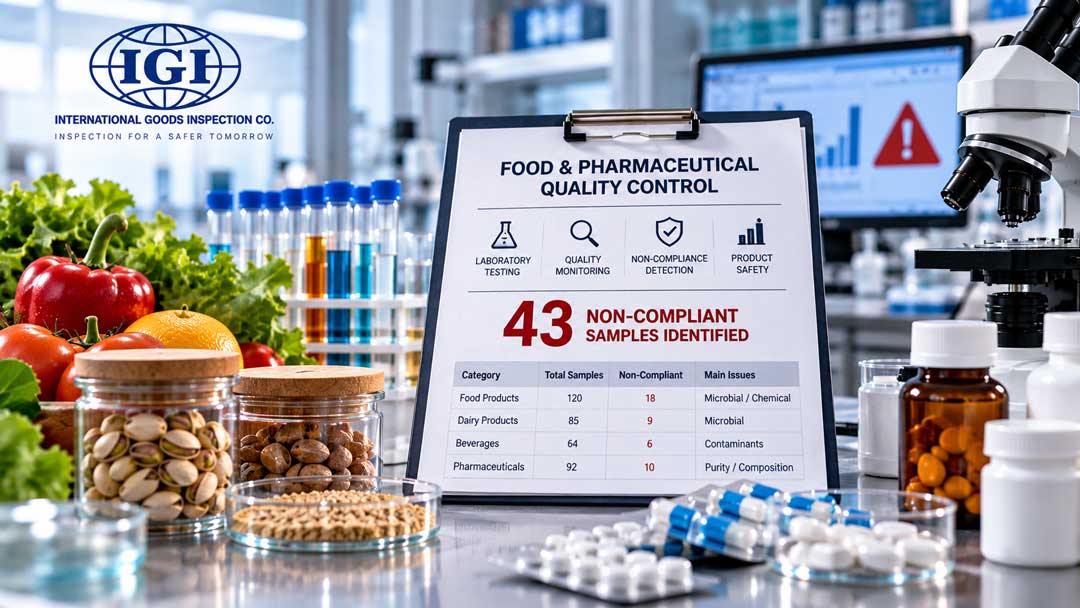
43 Non-Compliant Samples Identified in Food and Drug Quality Testing in Iran
43 Non-Compliant Samples Identified in Food and Drug Quality Testing in Iran
The Quality Control Laboratory of the Food and Drug Department at Zahedan University of Medical Sciences reported that 456 samples were examined and 43 non-compliant samples were identified after the required laboratory tests and evaluations.
The report was published on September 20, 2026. It provides a recent example of the role of laboratory testing in identifying products that do not comply with applicable requirements and standards.
Post-Market Surveillance Testing Continues
The same report states that 83 cosmetic and personal care product samples have also been submitted to the quality control laboratory under a Post-Market Surveillance or PMS program and are undergoing specialized testing.
Post-market surveillance allows products already available in the market to be monitored and tested after they have entered normal distribution channels.
Why Laboratory Testing Matters in Product Quality Control
Quality control of food, pharmaceutical, cosmetic and other consumer products cannot always rely on visual inspection or document review alone. Depending on the product, laboratory analysis may be required to measure chemical, physical, microbiological or other technical characteristics.
Laboratory testing allows analytical results to be compared with relevant specifications, standards and regulatory limits. This makes laboratory work an important part of product conformity assessment.
What Do the 43 Non-Compliant Samples Show?
The identification of 43 non-compliant samples among the 456 samples tested illustrates the value of continuous product monitoring and laboratory analysis.
The figure applies to the samples examined within the reported laboratory program and should not be interpreted as representing all products available in Iran.
The Importance of Representative Sampling
A laboratory result depends partly on the quality and representativeness of the sample submitted for analysis. Proper sampling, identification, handling and transportation help ensure that the analytical result provides meaningful information about the product or lot being assessed.
How Laboratory Testing Supports Non-Compliance Detection
The required tests depend on the product and the applicable requirements. Depending on the case, testing may involve chemical, physical, microbiological or other product characteristics.
Once testing is completed, analytical results can be compared with the applicable specifications, standards or regulatory limits to determine conformity.
Specialized Testing of Cosmetic and Personal Care Products
The report also notes that 83 cosmetic and personal care product samples are undergoing specialized testing under the PMS program. Such monitoring can provide ongoing information about product quality and compliance after products reach the market.
From Laboratory Testing to Market Surveillance
An effective quality-control system can include product specifications, sampling, analytical testing, result evaluation, record keeping and corrective actions where necessary.
These activities can help organizations identify non-conforming products and support quality decisions throughout the supply chain.
Importance for Supply Chain Quality Control
Laboratory quality control is not limited to finished products. Raw materials, imported consignments, manufactured products and export shipments may also require laboratory testing depending on product specifications and market requirements.
Laboratory results can complement inspection, document review and other quality-control activities when assessing product conformity.
IGI Laboratory Services
International Commercial Goods Inspection Company (IGI) provides specialized laboratory services alongside its inspection activities.
Learn more about IGI Laboratory Services.
For chemical testing and analysis, visit IGI Chemical Laboratory.
For microbiological testing, visit the IGI Microbiology Laboratory page.
Why Continuous Quality Monitoring Matters
Products can encounter different conditions throughout production, distribution and storage. Continuous monitoring and periodic testing can provide additional information about actual product quality after products enter the market.
Laboratory analysis may also identify issues that cannot be detected through non-analytical quality checks alone.
Conclusion
The Quality Control Laboratory of the Food and Drug Department at Zahedan University of Medical Sciences reported that 43 non-compliant samples were identified among 456 tested samples. At the same time, 83 cosmetic and personal care samples were undergoing specialized testing under a post-market surveillance program.
The report highlights the importance of representative sampling, laboratory analysis and continuous product monitoring in quality control and conformity assessment.
Source: ISNA / report on the activities of the Quality Control Laboratory of the Food and Drug Department at Zahedan University of Medical Sciences